Overview
About the program
The Postgraduate Diploma (PGDip) in Artificial Intelligence is a practical program for working employees, from Python and the mathematics of AI to machine learning, computer vision, language models, MLOps and AI on edge devices. It closes with a capstone project on a real challenge from the student’s organization.
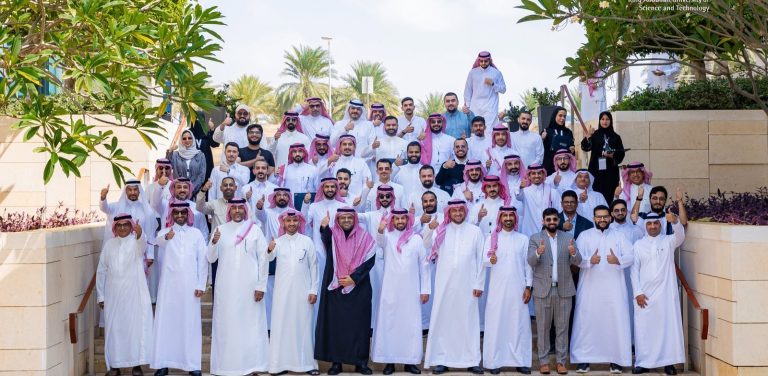
KAUST offers it to organizations, not to individual applicants, and teaches it with faculty from partner universities. Its graduates are prepared for roles such as AI developer, data analyst and machine learning specialist. KAUST currently runs the program for the Ministry of Interior.
A KAUST qualification
Graduates earn a postgraduate diploma awarded by KAUST, and the best can continue to the master’s degree.
At your organization
Classes run on weekends at the organization’s own venue, so employees keep working while they study.
Projects on your challenges
Capstone projects follow the organization’s priorities, with its technical teams co-supervising selected projects.
Admission
How students are selected
Every student starts with the bridging program. Their grades in it decide the program they join.
Step 1
Online preparation
4 weeks
Online, self-paced
The organization’s nominees study on their own for the screening exam.
Step 2
Screening exam
2 hours
Written exam
Those who pass join the bridging program.
Step 3
Bridging program
8 weeks
In person, Sunday to Thursday
Two weeks each of Python programming, linear algebra, calculus, and probability and statistics: the mathematics and programming behind AI, taught by KAUST faculty and experts from leading universities.
Certificate of completion
Step 4
Placement
An average above 90% and an English interview lead to the Master of Engineering in AI. An average above 75% leads to the Postgraduate Diploma in AI.
The bridging program prepares students but doesn’t guarantee a place. An interview checks each student’s English, and those who need it take an English course.
30 credit hours
Curriculum
Three semesters of courses, Thursday to Sunday, with online office hours and resources in between, then a summer capstone program at KAUST.
21
credit hours of courses
9
credit hours of capstone project
7
courses
8 weeks
Semester 1
Introduction to Python Core
Applied Mathematics for AI Core
16 weeks
Semester 2
Machine Learning Core
Computer Vision Applications Core
Natural Language Processing Applications Core
Semester 3
Machine Learning Operations (MLOps) Elective
AI on Edge Devices Elective
Summer · 6 weeks
Capstone
Capstone project at KAUST Capstone
The courses
Introduction to Python
Python for AI and data science: data types, control structures, functions and object-oriented programming, with NumPy, Pandas, Matplotlib, Jupyter notebooks and Git. 100 level. (all practice)
Applied Mathematics for AI
The linear algebra, probability, statistics and optimization behind machine learning and deep learning, implemented in Python labs. 200 level. (50% theory, 50% practice)
Machine Learning
Supervised and unsupervised learning, from regression and decision trees to random forests, XGBoost and LightGBM, clustering and dimensionality reduction, with a strong focus on preparing data. 200 level. (30% theory, 70% practice)
Computer Vision Applications
Image processing, augmentation and recognition with CNNs, ResNets and vision transformers, from building and annotating datasets to training pipelines in PyTorch and TensorFlow. 200 level. (30% theory, 70% practice)
Natural Language Processing Applications
Production-ready language solutions with transformers and large language models: fine-tuning (including LoRA), retrieval-augmented generation, knowledge graphs and AI agents. 200 level. (30% theory, 70% practice)
Machine Learning Operations (MLOps)
Taking models to production: data versioning, workflow orchestration, model serving, Docker and Kubernetes, experiment tracking and monitoring, in team projects. 200 level. (20% theory, 80% practice)
AI on Edge Devices
Compressing, quantizing and pruning models to run in real time on edge and embedded devices, with TensorFlow Lite, ONNX Runtime, Edge Impulse and NVIDIA Jetson. 200 level. (40% theory, 60% practice)
Capstone project
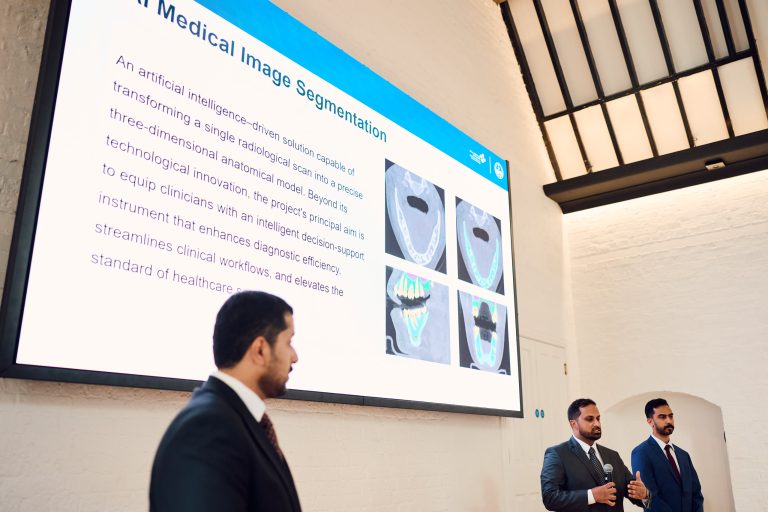
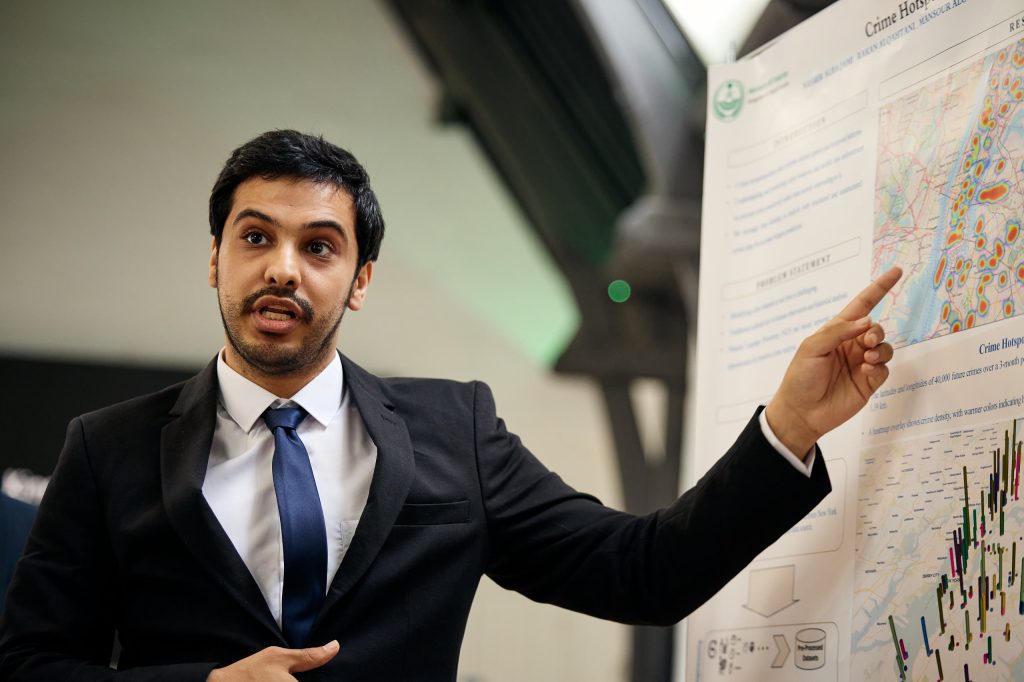
A project in machine learning, computer vision, natural language processing, data analytics, or IoT and embedded systems, on a use case from the organization. It closes the diploma with a six-week summer program at KAUST: four weeks of AI use cases and technical lessons alongside the project, then two weeks of full-time project work and a final presentation.
To earn the diploma, students need at least 30 credit hours, a cumulative GPA of at least 3.0 and at least a B- in every course.
Summer
A summer at KAUST, and for some, at Oxford
All students spend the six-week capstone summer at KAUST. Selected students then join the master’s students for three weeks at the University of Oxford, on generative models, language models and AI agents.
Now showing
MOI MEng AI: summer at Oxford 2026
All films (1)
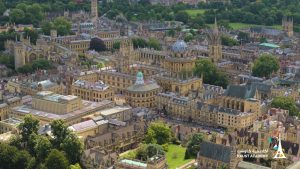
Master’s students at the University of Oxford, summer 2026.
Requirements
Who can join
A bachelor’s degreeIn science, mathematics or engineering, checked at registration.
Nominated by their organizationUsually employees early or midway in their careers who work, or will work, on AI projects.
A bridging average above 75%The screening exams must be passed too.
For organizations
Bring the program to your organization
Contact us
Send us a message through the contact form and choose “Degree programs for organizations”.
Plan the cohort
We agree with you on the schedule, the venue and the number of students.
Nominate employees
Your nominees prepare online, sit the screening exam and take the bridging program.
Start the program
The students admitted study on weekends at your venue, taught by KAUST faculty.
FAQ
Questions
Can I apply on my own?
No. KAUST offers this program to organizations for their employees. If your organization is interested, it can contact us.
Can diploma students go on to the master’s degree?
Yes. Students who finish the diploma with an A grade or a GPA of at least 3.8 can continue to the Master of Engineering in AI. Up to 18 credit hours of their 200-level diploma courses count toward it, and they complete it in two more semesters.
Where and when are classes held?
Thursday to Sunday, at the organization’s own venue, with online office hours, question-and-answer sessions and resources in between. The capstone summer is at KAUST.
Can students change program after admission?
No. And because each course builds on the one before, a student who fails a course leaves the diploma.